
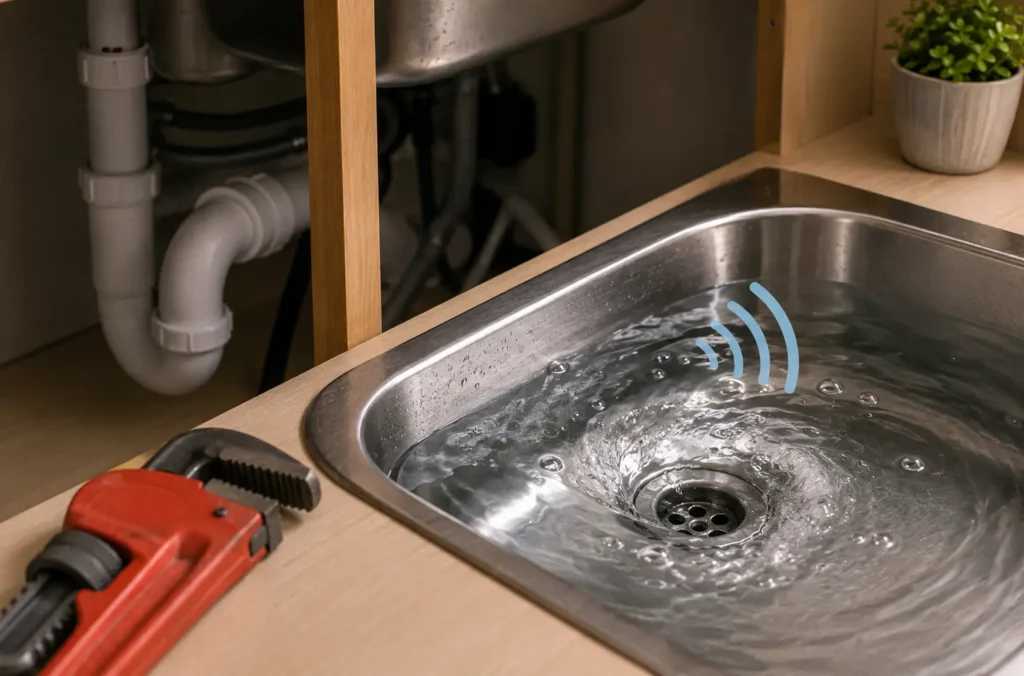
That gurgling sound coming from your drain isn’t just annoying — it’s your plumbing system trying to tell you something is wrong.
A gurgling drain is one of the most common plumbing complaints we hear from GTA homeowners. It usually starts subtle: a faint bubbling after you empty the sink, or a glug-glug from the toilet every time the washing machine drains. Easy to ignore at first. But in our experience as licensed plumbers serving Toronto and the surrounding area, a gurgling drain that’s left alone almost always turns into something bigger — a full blockage, a sewage backup, or a flooded basement.
This guide covers the six most common reasons drains gurgle, how to tell which one you’re dealing with, and the signs that mean it’s time to stop troubleshooting and call a plumber.
What does a gurgling drain actually mean?
A gurgling drain means air is moving through your drain system in a way it shouldn’t be. Under normal conditions, water drains smoothly and air moves freely through the vent pipes that run up through your roof. When something disrupts that balance — a partial clog, a blocked vent, a failing sewer line — air gets trapped and forced through the water in your pipes. That’s the gurgling sound you hear.
Think of it like a straw in a glass of water. When you cover the top of the straw with your thumb, the water stays put because of air pressure. Your drain system works the same way in reverse: when airflow is blocked or restricted, it creates pressure that bubbles back up through the nearest drain opening.
The gurgle is the symptom. The cause is somewhere in the system — and finding it is what determines whether this is a $15 bottle of drain cleaner or a call to a licensed plumber.
6 causes of a gurgling drain
Cause 1: A partial clog in the drain line
The most common cause of a gurgling drain is a partial blockage somewhere in the pipe. Hair, grease, soap scum, and food debris build up over time and narrow the pipe diameter. Water can still pass through — slowly — but the restriction creates negative air pressure that pulls air backward through the drain, causing that familiar bubbling sound.
What it sounds like: Gurgling right after the water drains, typically from one specific fixture — a bathroom sink, the shower, or the kitchen drain.
What to try first: A drain snake (also called an auger) can break up or pull out the clog for simple blockages close to the drain opening. Avoid chemical drain cleaners — they’re corrosive to older pipes, rarely solve the root problem, and can make a plumber’s job harder.
When it becomes a plumber’s call: If the clog keeps coming back, or if you’ve snaked the drain and the gurgling continues, the blockage is likely further down the line or is being caused by grease and debris coating the pipe walls — which requires to clear properly.
Cause 2: A blocked or frozen drain vent pipe
Every drain in your home connects to a vent pipe that runs up through the roof. These vent pipes do two things: they allow sewer gases to escape outside, and they let fresh air into the drain system to maintain the pressure balance that keeps water flowing freely.
When a vent pipe gets blocked — by a bird’s nest, leaves, debris, or in a GTA winter, ice — the drain system loses its air supply. Water draining through the pipes has to pull air from somewhere, so it pulls it backward through the nearest trap. That’s the gurgling.
What it sounds like: Gurgling from multiple fixtures at once — the bathroom sink gurgles when you flush the toilet, or the shower gurgles when the dishwasher drains. Multiple fixtures gurgling is a strong indicator the problem is in the venting system, not a single drain.
What to try first: In winter, a frozen vent cap is a common cause in Toronto and the GTA. If you can safely see the vent stack from the roof or through an upstairs window, look for visible ice buildup. Do not attempt to clear a vent pipe from the roof yourself — roof access in winter is hazardous.
When it becomes a plumber’s call: Blocked vent pipes typically require a licensed plumber with the right equipment to clear safely. This is not a DIY job.
Cause 3: A problem with the P-trap
The P-trap is the curved section of pipe under every sink, shower, and floor drain. It holds a small amount of water that acts as a seal, preventing sewer gases from rising back up into your home. When the P-trap dries out, gets partially blocked, or fails, air and gas can move through it in both directions.
What it sounds like: A gurgling or bubbling sound from a drain that isn’t used often — a guest bathroom sink, a basement floor drain, or a utility sink. The gurgle may be accompanied by a faint sewage smell.
What to try first: If the drain is rarely used, the P-trap may have simply dried out. Run water into the drain for 30 seconds to refill the trap seal and see if the gurgling and odour stop.
When it becomes a plumber’s call: If refilling the trap doesn’t solve it, the P-trap may be cracked, incorrectly installed, or the issue may be further downstream. A plumber can inspect and replace a P-trap quickly — it’s one of the more straightforward fixes in plumbing.
Cause 4: A main sewer line blockage
This is the one that matters most. Your home’s individual drain lines all connect to a main sewer line that carries everything out to the city sewer system. When the main line gets partially or fully blocked — by tree roots, grease buildup, or a collapsed pipe — it backs pressure up through the entire system.
What it sounds like: Multiple drains gurgling simultaneously, slow drains throughout the house, water backing up into the basement floor drain when you run a shower or washing machine upstairs, or sewage smell coming from floor drains. In severe cases, flushing an upstairs toilet causes water to bubble up from a downstairs drain.
What to try first: Nothing. A main sewer line blockage is not a DIY situation. Using chemical cleaners or a standard drain snake on a main line without knowing the cause can make the problem worse — especially if tree roots or a pipe collapse are involved.
When it becomes a plumber’s call: Immediately. A main line blockage that backs up sewage into the home is a health hazard and should be treated as an emergency. [INTERNAL LINK: emergency plumbing] A licensed plumber will use a CCTV camera to inspect the line, identify the cause, and recommend the right solution — which might be hydro-jetting for a grease or root clog, or pipe repair/replacement if the line has collapsed.
Many Toronto-area homes — particularly pre-1980 properties in neighbourhoods like Leslieville, Roncesvalles, and North York — still have original clay tile or cast-iron sewer laterals that are highly vulnerable to tree root intrusion. If your home is over 40 years old and you’re hearing widespread gurgling, a sewer camera inspection is a smart first step before a backup occurs.
Cause 5: Improper drain venting or installation
Sometimes the gurgling isn’t caused by a blockage at all — it’s caused by a drain that was never properly vented in the first place. This is common after renovations where new drains are added without proper connection to the vent system, or in older homes where the original plumbing didn’t meet today’s building code standards.
What it sounds like: Persistent gurgling that started after a renovation, or that has always been present in a specific fixture since you moved in.
When it becomes a plumber’s call: This is always a plumber’s call. Fixing improper venting means accessing the existing vent system and adding or extending venting — work that requires a licensed plumber and, in most cases, a building permit in Toronto.
Cause 6: City sewer or shared line issues
In some cases, the gurgling isn’t coming from your plumbing — it’s coming from the city’s sewer system. During heavy rainfall, Toronto’s combined sewer system can become overloaded, which creates backpressure in the lateral lines connecting homes to the main. That pressure can push back through floor drains and cause gurgling even when nothing is wrong with your home’s internal plumbing.
What it sounds like: Gurgling from basement floor drains or toilets during or immediately after a heavy rainstorm, with no other symptoms between weather events.
What to do: This is worth noting to the City of Toronto (311), and it’s a strong argument for having a backwater valve installed. The City of Toronto’s Basement Flooding Protection Subsidy Program covers up to $3,400 toward backwater valve installation for eligible homeowners — a licensed plumber can handle the installation and guide you through the rebate application.
When to stop troubleshooting and call a plumber
Here’s the clear line. Handle it yourself if: the gurgling is isolated to one fixture, it started recently, and it resolves after you clear a visible clog near the drain opening.
Call a licensed plumber if any of these apply:
- Multiple fixtures are gurgling at the same time — this points to a main line or venting issue that requires professional diagnosis.
- You smell sewage near any drain — sewer gas contains hydrogen sulfide, which is both toxic and flammable.
- Water is backing up into the basement floor drain, bathtub, or toilet when you use other fixtures.
- The gurgling keeps coming back — recurring clogs in the same drain usually mean a deeper issue that a drain snake isn’t reaching.
- You have an older Toronto home (pre-1980) with known clay or cast-iron drain lines — tree roots are the most common cause of main line failure in mature GTA neighbourhoods, and catching it early is far cheaper than dealing with a full backup.
- The gurgling started after a hard winter — frozen vent pipes are common in the GTA, and icicle formation at roof vents is a sign the system needs clearing before spring thaw creates a blockage.
How Professional Plumbing diagnoses a gurgling drain
When we get a call about a gurgling drain, we don’t guess. Our process:
- We ask a few quick questions to narrow down which type of gurgling it is — single fixture or multiple, when it started, any recent changes to the home.
- We run a physical inspection of accessible cleanouts and drain openings.
- For suspected main line issues, we run a CCTV camera down the sewer lateral to see exactly what’s causing the problem — root intrusion, grease, a belly in the pipe, or a collapse.
- We give you a flat-rate quote with a clear explanation of the cause and the fix before we start any work.
No surprises. No overtime charges. Just a straight answer and a licensed plumber who gets it done.
Frequently asked questions about Gurgling drains
Is a gurgling drain an emergency?
A gurgling drain from a single fixture is not usually an emergency — but it’s worth addressing within a few days before the partial clog becomes a full one. Multiple gurgling drains, sewage smell, or water backing up anywhere in the house should be treated as an emergency and addressed immediately.
Can I use drain cleaner to fix a gurgling drain?
Chemical drain cleaners can temporarily clear a partial clog close to the drain opening, but they don’t address deeper blockages, vent problems, or main line issues. They’re also corrosive to older pipes and can damage PVC if left in too long. A drain snake is a safer first step for DIY attempts; anything beyond that is better handled by a plumber.
Why does my toilet gurgle when I run the shower?
When two fixtures share the same drain or vent line, a partial blockage or venting problem in that shared section causes air to travel between them. Flushing the toilet or draining the shower pushes air back through the other fixture’s trap. This is a strong sign of either a shared drain clog or a vent pipe problem — both of which need a plumber.
How much does it cost to fix a gurgling drain in Toronto?
A simple drain snake service for a single gurgling drain typically costs $150–$350 in Toronto. If the problem is a blocked vent or main line clog requiring hydro-jetting or camera inspection, costs range from $300–$800+. Sewer line repairs start at $1,000+ depending on the scope. Professional Plumbing provides free, upfront flat-rate quotes before any work begins — call us at +1 (437) 247-7856.
Why does my drain gurgle more in winter?
Cold winters in the GTA cause vent pipes to ice over, restricting airflow into the drain system. This is especially common in January and February when overnight temperatures drop below -15°C. A plumber can safely clear a frozen vent pipe and — if it’s a recurring problem — recommend a frost-proof vent cap to prevent it happening again.